What Is the Human Biofield?
The Science Explained
Your heart generates an electromagnetic field that can be measured outside the body with sensitive instruments, the same kind of signal behind everyday medical tests such as ECG and MEG. Whether these fields carry meaningful information between people, or affect health, is still being researched. Each claim below is labeled by how strong the evidence is.
The Science of the Human Biofield
The term biofield was coined in 1992 at a conference hosted by the National Institutes of Health Office of Alternative Medicine, as an umbrella word for research on the fields in and around living bodies. It is a proposed concept rather than an established finding: researchers still disagree about what the biofield is and whether it is more than known bioelectromagnetic signals.
James Oschman — Energy Medicine: The Scientific Basis (2000)
James Oschman proposed in his 2000 book that connective tissue works as a body-wide living matrix that may carry electrical and mechanical signals between cells. This is a hypothesis, not an established finding. Cell signaling through connective tissue is real, but claims of instant, body-wide electromagnetic communication are not supported by mainstream evidence.
Heart Coherence: Your Most Powerful Biological Signal
The HeartMath Institute, a research organization focused on heart rhythms, has published studies on how the heart communicates with the brain and body through nerve, hormonal and electromagnetic signals. Much of this research comes from the institute itself, and independent replication is more limited. The heart produces the strongest electromagnetic field of any organ in the body.
Key Finding: 60x Stronger Than the Brain
HeartMath researchers report that the heart electrical signal (ECG) is about 60 times larger in amplitude than the brain signal (EEG), and that its magnetic component is about 5,000 times stronger and can be detected several feet from the body with highly sensitive SQUID sensors. They also report that heart rhythms can synchronize between people in close contact. These figures come from a 2003 HeartMath paper (McCraty, The Energetic Heart); the synchronization findings are early and have not been broadly replicated.
Heart Coherence & Immune Function — Clinical Evidence
Rein, Atkinson & McCraty (1995) studied people who intentionally generated positive emotional states and reported a significant rise in secretory IgA, an immune marker measured in saliva. Anger did not significantly change IgA in the same study. This was an early study, and a later meta-analysis of positive-mood interventions found a moderate increase in sIgA. Whether this changes how often people get sick has not been established, so emotional state is best described as one possible influence on immune markers, not a direct immune switch.
Heart Coherence Practice: 5-Minute Protocol
The Quick Coherence Technique is a simple slow-breathing and positive-emotion practice from HeartMath that needs no equipment. Small studies and reviews suggest it can raise HRV coherence and may help with stress, but the evidence is still early and much of it comes from HeartMath-affiliated groups.
The Protocol
Step 1: Focus attention on the area of the heart (center of chest). Breathe slowly and evenly — 5 seconds in, 5 seconds out. Step 2: On each exhale, recall a genuine feeling of appreciation, gratitude, or care for someone or something. Not a thought — a felt sense. Step 3: Sustain for 5 minutes. This specific combination of breath rate and positive emotion is designed to promote HRV coherence. Practice before high-stakes situations, upon waking, or before sleep as a calming routine.
Biofield Sovereignty: Protecting Your Electromagnetic Territory
Biofield sovereignty is a lifestyle idea: being intentional about the people, devices and environments you spend time around. The practices below are comfort and stress-regulation habits. There is no good evidence that outside fields change your biofield.
Field Contamination & Recovery
HeartMath researchers (McCraty) report that heart rhythm patterns can synchronize between people in close contact, within about 5 feet in their studies. This is early-stage research that has not been broadly replicated, so it is labeled Speculative here. After a stressful day, many people find these practices calming: time in nature, slow heart-coherence breathing, sound such as humming or singing bowls, and a cool shower. They are comfort practices, not proven ways to change a field.
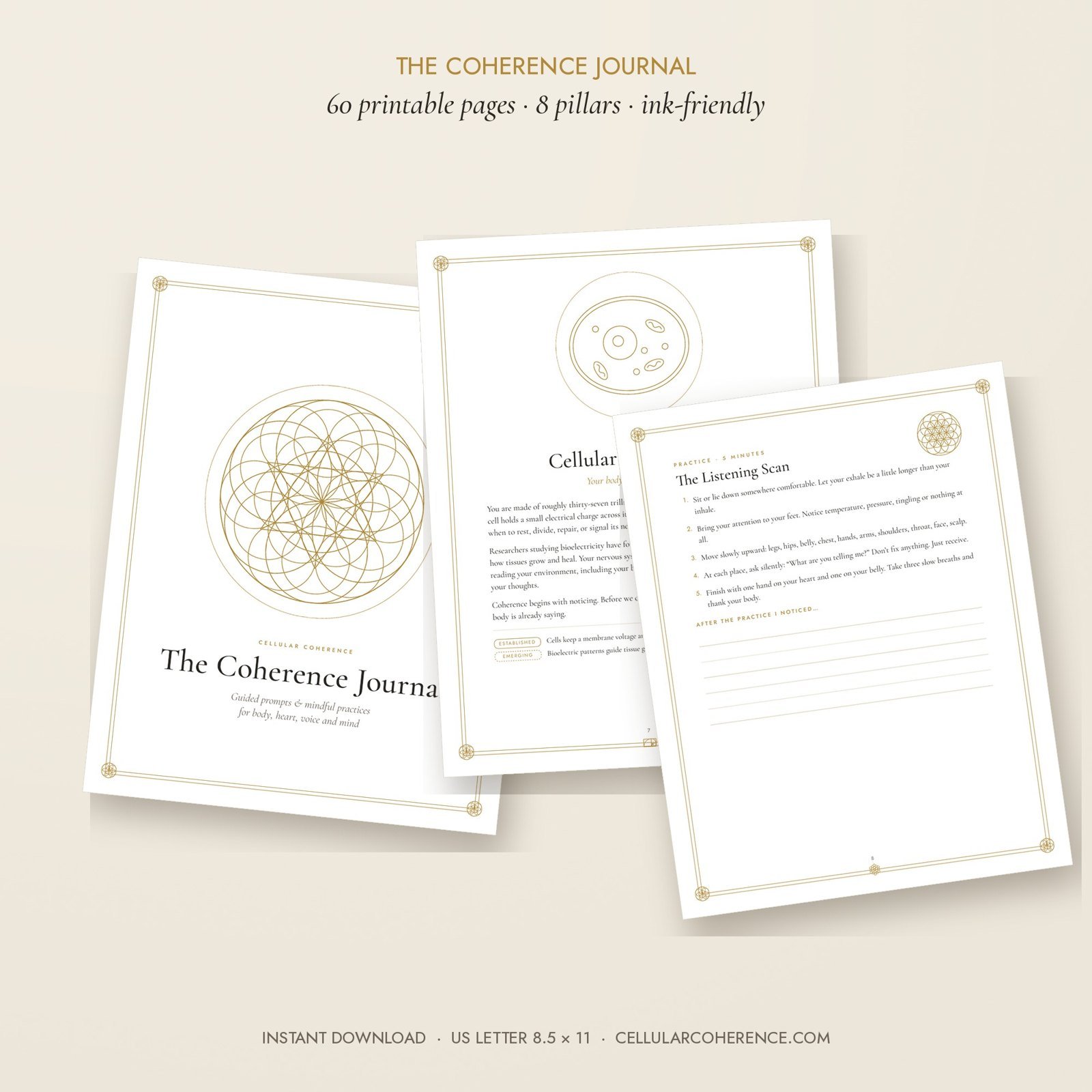
The Heart & Biofield in The Coherence Journal
Turn this page into a daily practice: the five-minute heart coherence practice, six reflective prompts and a seven-day log, part of a 60-page printable journal with every claim labeled by evidence.
Apply This to Your Biology
Your personalized protocol built from your biofield profile and these pillars.